
Edited video materials
Written and edited by Eszter Ruttkay-Miklián
Éva Schmidt’s legacy has a special unit that is on the intersection of collection, processed material and publication. These video selections contain materials chosen from the collections organized around some theme, have titles, tables of contents with captions, and the text spoken in them is often transcribed. The theme is usually defined by the person of an outstanding performer, a genre or the folklore characteristic of a region.
Recordings made available to the public
From the very beginning, Éva Schmidt always considered it a fundamental task of the Archive to make past as well as more recent collections available to the public, from families of the informants to public institutions. It was natural for her to always send a copy of audio and video recordings to the place of recording. A fundamental principle of her activities was to create an opportunity for the interested Khanty to relearn their own culture. Getting the collections back to their source served the dual purpose of empowering the informants and education. There was a reason for sending these edited materials to schools and museums: “The field recordings of the folklore educational and video programs for the schools of the Ob region are more or less complete, their editing is due in 1996. Interestingly, the closest cooperation was developed with Lopkhari village in the Jamal-Nenets Autonomous District. I edited the local repertoire of tales into a sizable video and audio tape program for its deprived school in 1995.” – she wrote in her 1995 report, and she continued later in the 1999 report (Reports from Siberia (SÉK 1.): 86; 142.): “I devoted the year to the study of Kunovat’s prosaic folklore, as there are no academic publications about this area at all. I have 5 hours of video recordings of tales from my previous expedition (M. A. Muratova és S. T. Tojarov), which I have edited under the title Tales of Kunovat into 150 sheets of manuscript transcribed phonemically, and a video educational program.”
Excerpts serving as examples
In order to achieve the above – representative and educational – purposes, the main guideline of editing was to choose the best and most characteristic pieces in a given genre or from a given informant. The fact of editing is probably most spectacular in the collection titled Song-Folktales, which presents the genre from different dialect areas, and the prosaic presentation of the story in question is also included in addition to the sung tale. While processing the recordings, we also discovered that Éva Schmidt ’amended’ the recording: she edited out the confusing part from the series of events that the performer mixed up. While editing, she also aimed to introduce the performers, the settlements and the landscape through small glimpses.
The Brand of the Northern Khanty Folklore Archive of Belojarskij
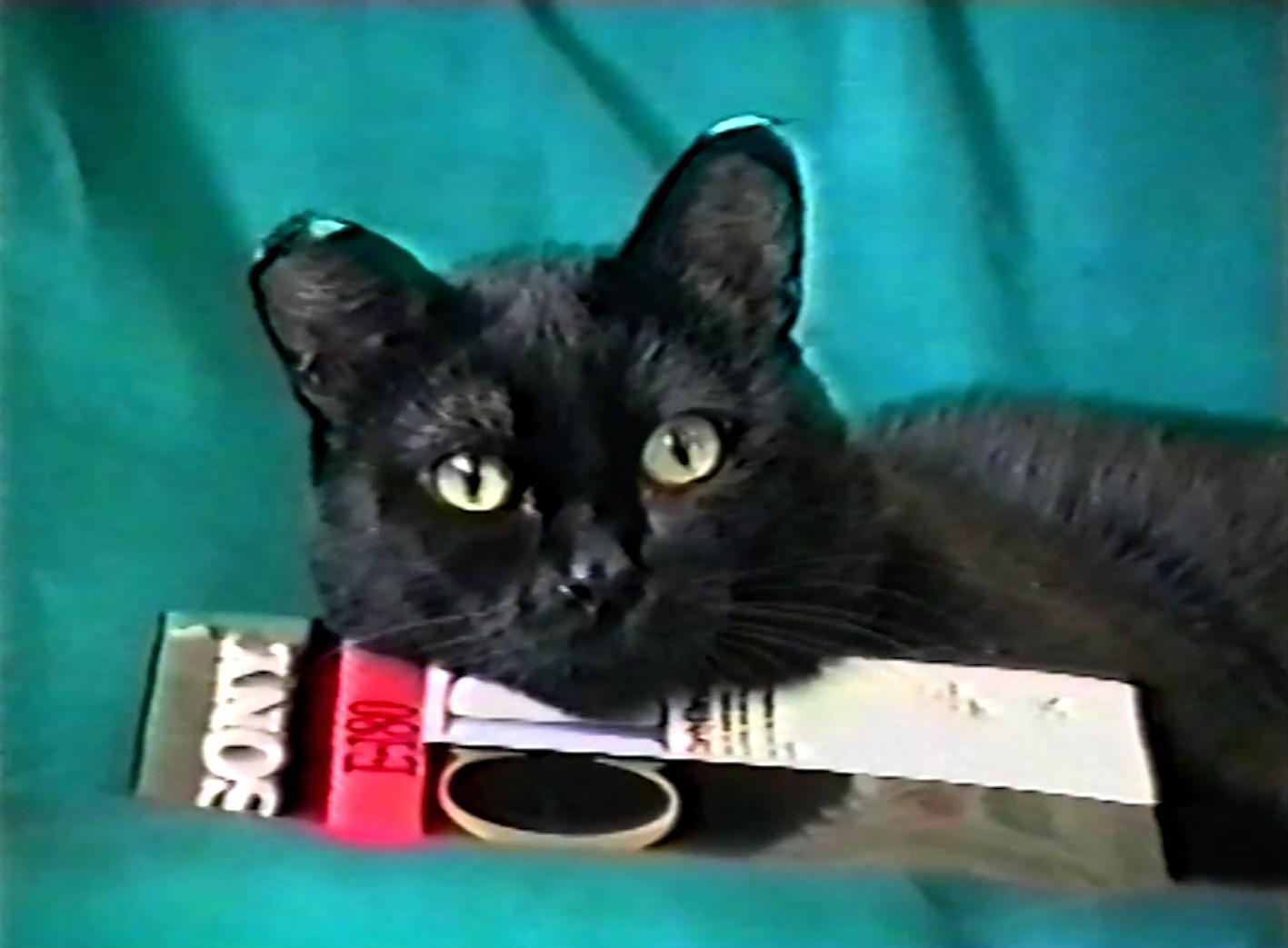
Éva Schmidt graduated from an art secondary school, she drew beautifully, and kept an eye on the aesthetic qualities of the works. With regard to the institution she was directing, she found it important to create the right brand image. So the archive had a logo, which was used on publications and at events. In the staff rooms portraits and maps drawn by Éva and her colleagues illustrated the activities of former researchers, and she also created a short intro for the edited video materials. In this video recording, the archive’s cat – a black cat with a white chest patch – is lying down, guarding a video cassette, while jew’s harp music is playing. The cat – especially in this colour – is the animal form of the Kazym Goddess. This role used to be filled by the sable, but with the spread of cats and given the similarity of the two animals, the function was extended to cats as well. Belojarskij, where the archive headquarters used to be, is situated along the Kazym river, the domain of the Kazym Goddess. This is why the introductory sequence appeals for her protection for the recordings.
The subtitles in the edited videos are usually in Khanty language and Cyrillic script, as the material was made for the Khanty audience. We occasionally find Russian subtitles as well. The data also include the name of their maker, Éva Schmidt, and the year of making. Khanty and Mansi sources included without translation clearly indicate that the target audience is the indigenous population who still spoke their mother tongue. However, the edited form – opening image, title, naming the people featured as well as the author – also projects a sense of sincerity and formality.
Transcription as publication
While the edited recordings only feature the name of the singer or person telling the tale and the title of the folklore artwork, the majority of the texts presented is also available in written form. These can be considered published texts, and are listed among the publications in Éva Schmidt's yearly report (Reports from Siberia (SÉK 1.): 142.): “Video programs from Kunovat with text transcripts, edited from earlier recordings, are considered to be publications”. The transcripts themselves are meant for the academic community, as they were written in the Finno-Ugric phonemic script. These texts are computerized materials almost ready for printing, they can typically be found in printed form as well as in some digital format in the legacy. However, no translation has been made in any language, except for the material of the Song-Folktales, which have been published as a book in Khanty with Russian translations. The bulk of the transcripts can be considered a final draft, though in some cases questions and remarks were left in the manuscript. In our current categorization, these materials were included with the manuscripts.
On the publication of the edited video materials
While there are a number of materials in Éva Schmidt’s legacy that were compiled or recorded as programs, here we specifically present those that meet the criteria explained above. With the video materials, we include the name of the performer and the title of the artworks presented, as well as the time codes within the edited materials. In the first instalment, we present the transcribed texts available as digital copies of the version printed out by Éva Schmidt. For the time being, processing only involves a small amount of translation.