
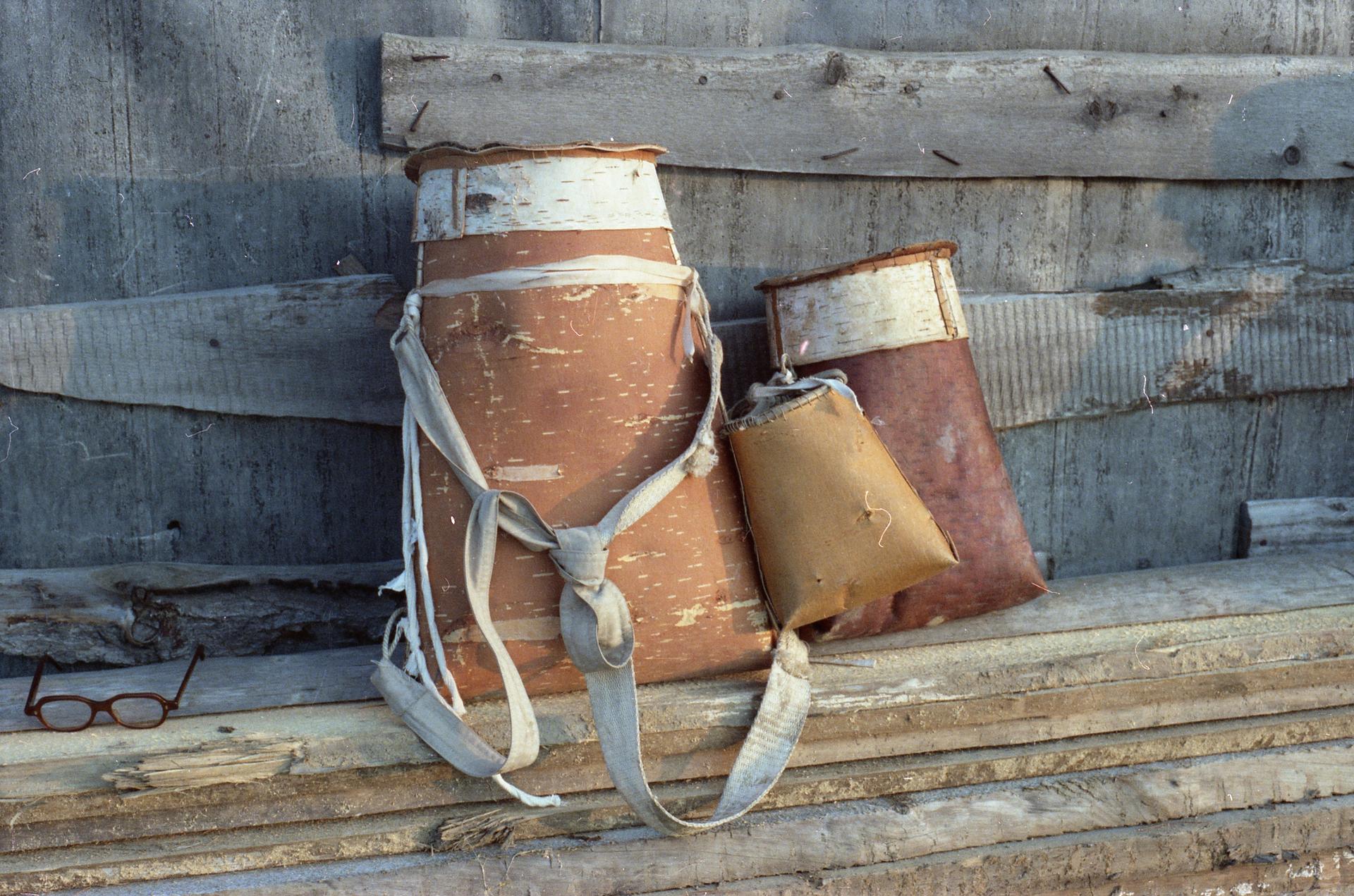
two skis (meant for) men to bind
did (she), woman, bind,
two ski bases (meant for) men to put on
did (she), woman, put on.
many flood lakes with grassy edges
did she walk through, too,
many flood lakes with cane-grown edges
plenty of them she did walk.
Black-tailed tailed ermines
did (she), woman, carry (home),
black tailed many ermines
did (she), woman, carry (home).
Vera Griskina
Khanty and Mansi personal songs collected by Éva Schmidt
and in the following days (well perhaps two days later or so)
the action titled the painting of the house set in,
and upon this, I was relocated to Vera Griškina’s house
– it is thanks to this, these were the kinds of turns that fate took...
So this painting event has defined my life.
Vera Griškina’s songs, which have become unparalleled also by now...
Éva Schmidt
One would not imagine, looking at the volume and richness of the collected treasury of songs, that during her two expeditions Éva Schmidt also had to cope with the unpredictable and chance circumstances that often characterize fieldwork. All that she has created through the collection and processing of the songs is no thanks to tranquil work circumstances, but rather to her firm determination, in possession of her previously acquired knowledge, to record everything of value. The results of the two successful fieldworks outline the unique song culture of a tiny West-Siberian people, and do this in its movement and change: bearing archaic traits, while also enabling us to study how this song poetry quite naturally responds to the changing social and cultural environment.
The digitized version accessible on the website is based on the researcher’s own processing. Still in the 1980s, the collected materials were supplemented with Katalin Lázár’s musical scores thanks to the collaboration of the two researchers, so these also fall into the category of the original processing of the songs. The result of their work is a quite exceptional, complex analysis, which covers the tune and the text, their interrelations, the details of the process of authoring songs, as well as the genesis of the songs.Éva Schmidt and the research of personal songs
till then, I will think about the songs that did not come to my mind this time!
Hurry up though, for I am already eighty years old!”
And she adds as I am leaving:
„Or if not, then at least get them to put that singing whatnot in your coffin,
so we can continue...”
Éva Schmidt
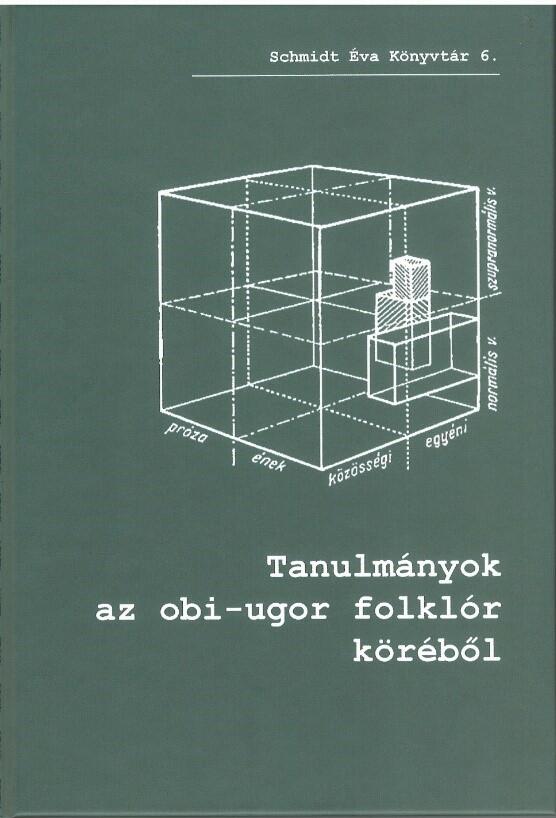
Éva Schmidt’s research interest turned intensely towards the personal songs in the first half of the 1980s. This meant, on the one hand, fieldwork and the processing of the recorded material later on: she put down the songs, translated them into Hungarian, added notes and prosodic analyses to them (unfortunately, such complete processing was not realised for all of the songs). On the other hand, she wrote papers and studies of varying length in the topic of personal songs about issues of genre.., prosody, metrics, ....and also devoted a separate study to the special “song language” names of settlements .. These, together with many other papers by her in the topic of folklore have been gathered and published in Volume 6 of the Éva Schmidt Library in Hungarian.
She wrote about the custom and practice of creating songs in the most evocative way in her popular science works .... In other words, the treasury of songs that can be explored on this site provided Éva Schmidt with the basis for writing the studies mentioned above.
The collection comprises 103 pieces, a total of 5.771 lines of song. Their length varies between 6 and 370 lines, though the shortest ones are obviously fragments. The vast majority of them is in Khanty (Kazym and Šerkaly dialects), but a small number of songs also represent the northern Mansi dialect.
What do we call a personal song?
that every self-respecting person should author songs.
Éva Schmidt
Éva Schmidt also used the term personal song in a wider sense. It refers to a group of genres rather than a single genre, which is justified to the layperson by the diversity of themes in itself. It includes songs about the author’s course of life – the reason why the category used to be labeled fate song –, improvisations, poems that accompany monotonous actions, such as a long journey or rowing, songs of complaint, songs of praise and self-praise, as well as pieces relating social or psychological conflict. Certain stories are also told “in a personal song manner”, and we also encounter them as part of bear ceremony rituals. That is, the personal song also has a living connection with other genres..
In addition to coining a more accurate term, Éva Schmidt also elevated the definition of the genre group to a new level. This definition was born from a knowledge of the totality of the Ob-Ugric song culture. She determined binary traits based on the core characteristics of each folklore genre: collective – individual, to be dispersed – not to be dispersed, sacral – profane, song – prose, non-epic – epic, dramatic – non-dramatic, objective – subjective. .. By applying these, Éva Schmidt avoided arbitrary descriptions of the genre, and made it possible to grasp correspondences and differences in comparison with other Ob-Ugric as well as the European genres.
Significance of the collection
is preserved in a transitional form between fixed and improvised text in Khanty memory, and
the text is readjusted to the tune every time.
Éva Schmidt
The songs recorded between 1980 and 1982 have special significance due to a number of factors.
On the one hand, it constitutes great value in itself that Éva Schmidt’s collections offer a detailed picture of a certain era: of the songs created in the beginning and middle of the 20th century and of the practice of creating songs in the second half of the century, and as a result, we can gain information about the genre in ways other than through the earlier songs.
On the other hand, the researcher did her fieldwork in precise knowledge of the questions that had been raised by then about the characteristics of the genre, the genesis of the songs, the way the texts are tied to their authors. Therefore she always inquired about this kind of data from her informants, and meticulously registered it in the part about the preliminary history of the song.
The linguistic processing of the songs is also characterised by outstanding precision and high standards. She wrote explanatory notes to the problematic points of the Khanty text, and also justified certain solutions in the Hungarian translation. She also added to the Hungarian text the cultural, historical, local and family historical, mythological etc. information that is necessary for the reader to understand the text better. In all of this, she continued the tradition of “explanations on language and cultural issues” known from Uralic publications at a very high level.
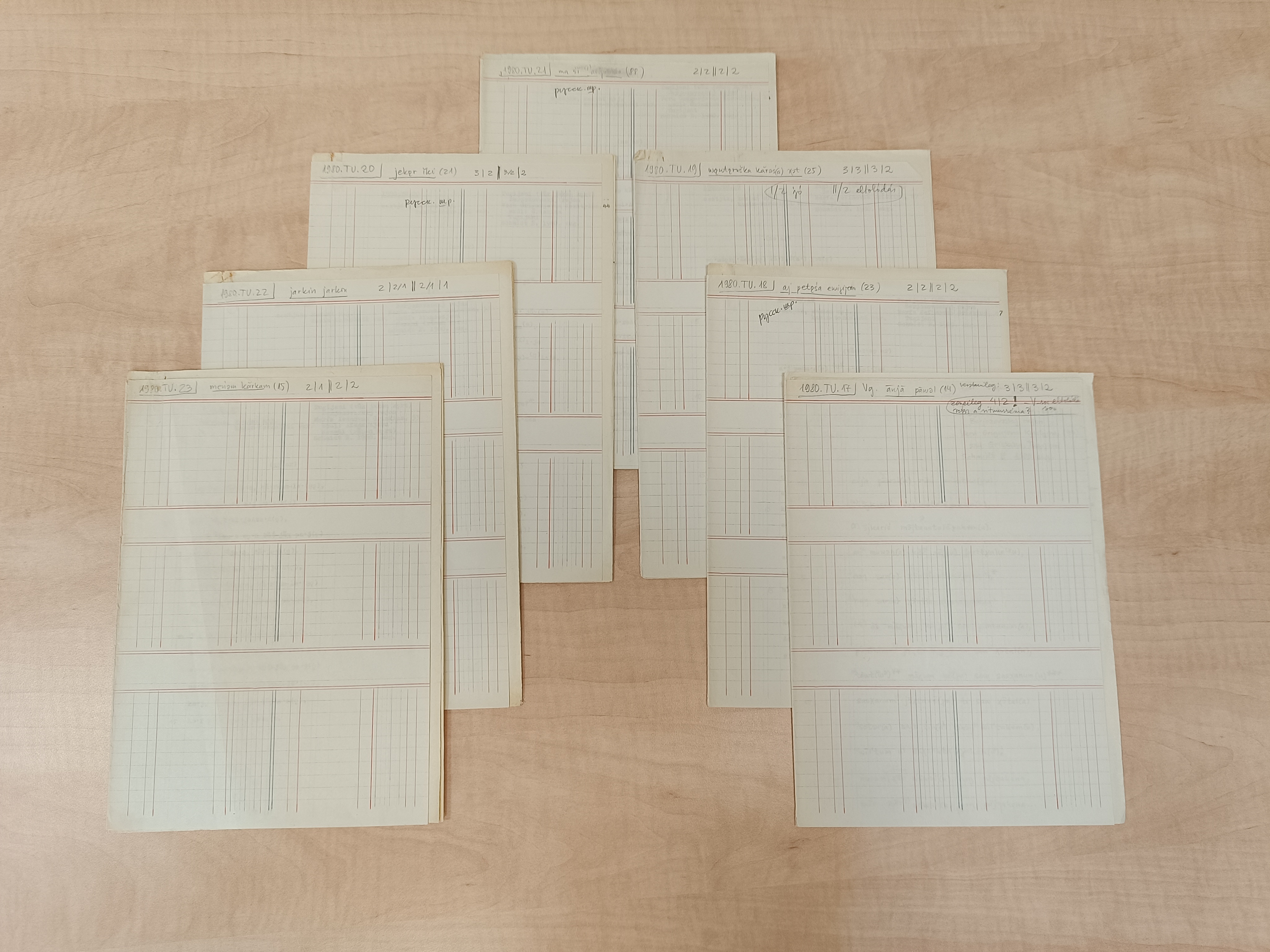
It was also the deep knowledge of Ob-Ugric song culture that motivated Éva Schmidt to describe the mechanism of creating and performing songs. In her study, she explored the system of rules that govern the synchronisation of the musical lines and the – consistently far shorter – textual lines. She described the typical prosodic structure of the lines and the solutions for multiplying syllable numbers in accordance with the ideal stress structure in several publications, for example .The handwritten tables showing the placement of filler syllables, derivational suffixes and words give an account of the repertoire of tools and system of rules found in each song. These tables do not only present the prosodic characteristics in the strict sense, but also demonstrate the interplay of numerous other factors of Ob-Ugric song poetry (the order of nominal and verbal lines, formulas, parallel lines, filler elements, etc.).
A further folkloristic significance of the songs is that they provide a basis for a good description of the genre, and for research questions that have been previously raised in the literature. They offer excellent examples for the kinds of genres and sub-genres that can occur within the personal song. More importantly, we can study how the information linked to the songs was preserved if they were created significantly earlier than the time of collection, as well as the path that a song can follow between sub-genres.
Presentation of the songs on the website
After answering a certain number of trivial questions,
the free hunter degraded to an informant
would usually just abandon the researcher.
This is the most long-standing tradition.
Éva Schmidt
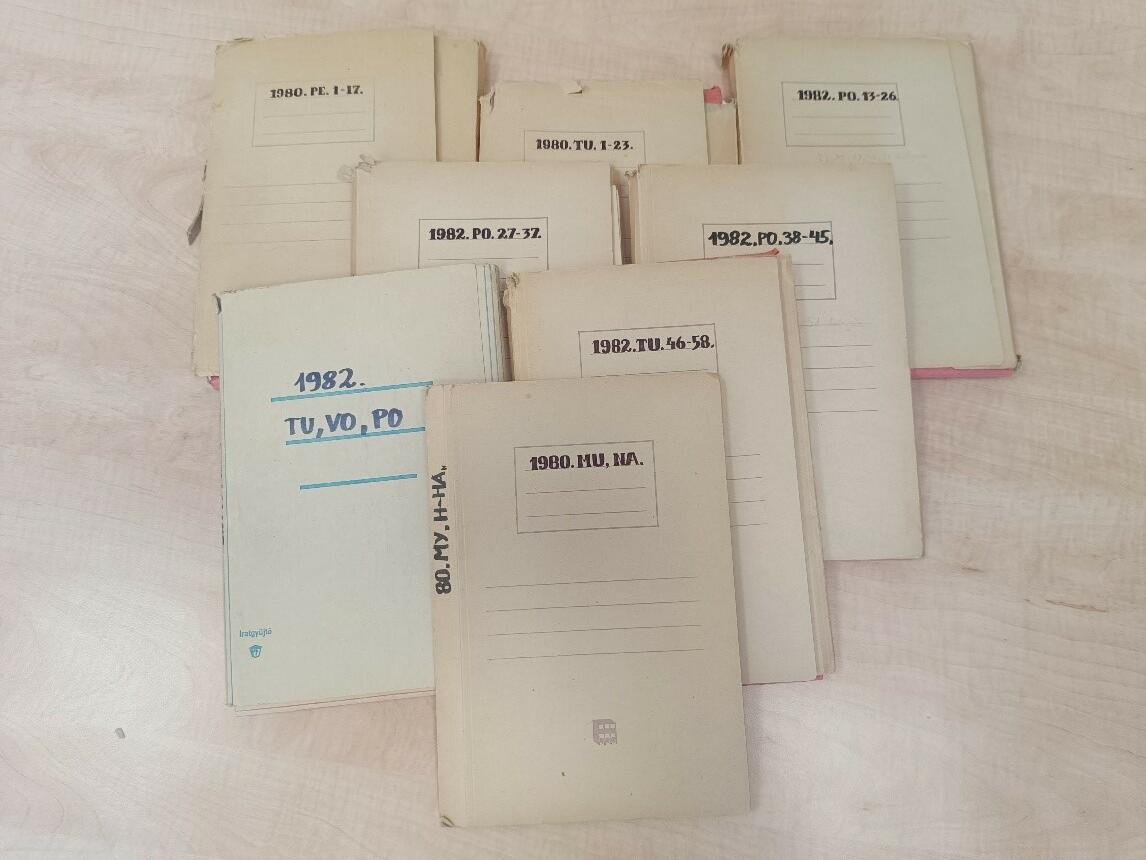
The first step was putting down the Khanty text based on the audio recordings, and the subsequent work can be assessed by the volumes of manuscripts with thorough metadata additions.
The note material, for which, as attested by the above report, the linguistic background information was not so easy to acquire, constitutes enormous added value.
The most thoroughly processed songs comprise the following parts:
- (a) Khanty script,
- (b) Hungarian translation,
- (c) background information relating to the songs,
- (d) linguistic comments on the Khanty texts,
- (e) explanations on culture, family and local history etc. (linked to the Hungarian translation),
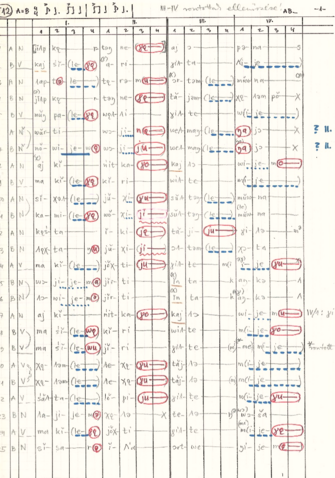
- (f) metric (prosodic) table,
- (g) musical script (score) and analysis.
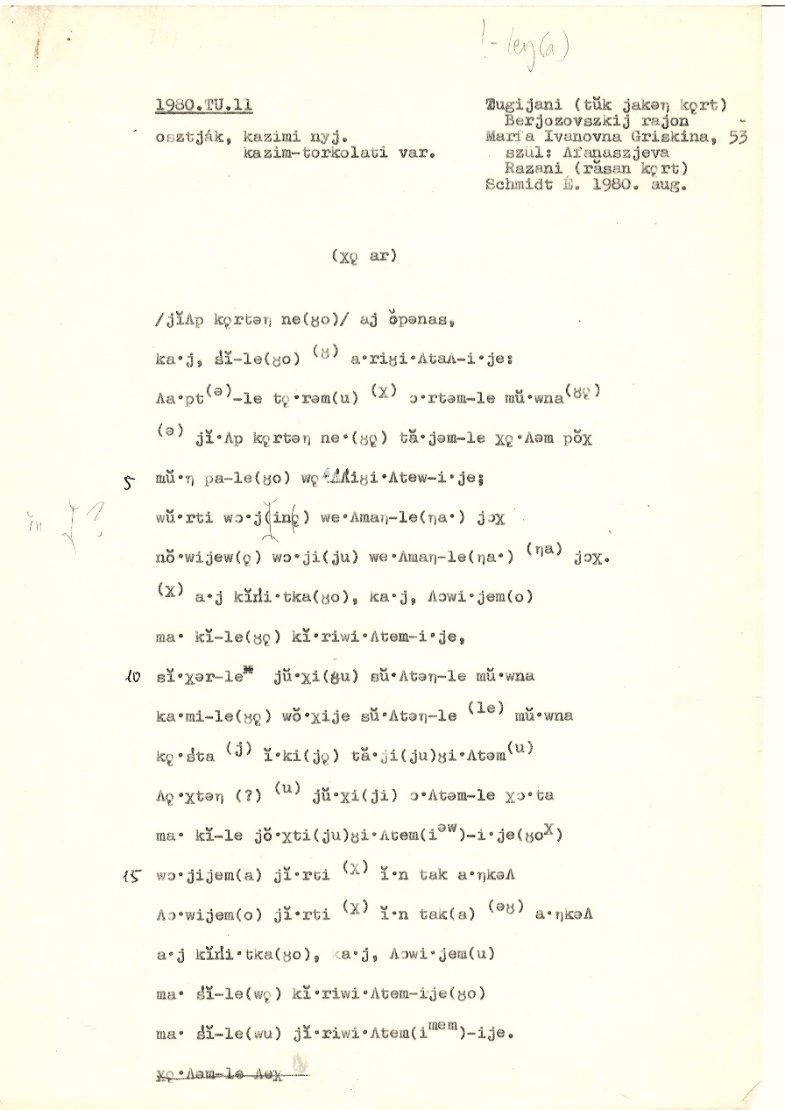
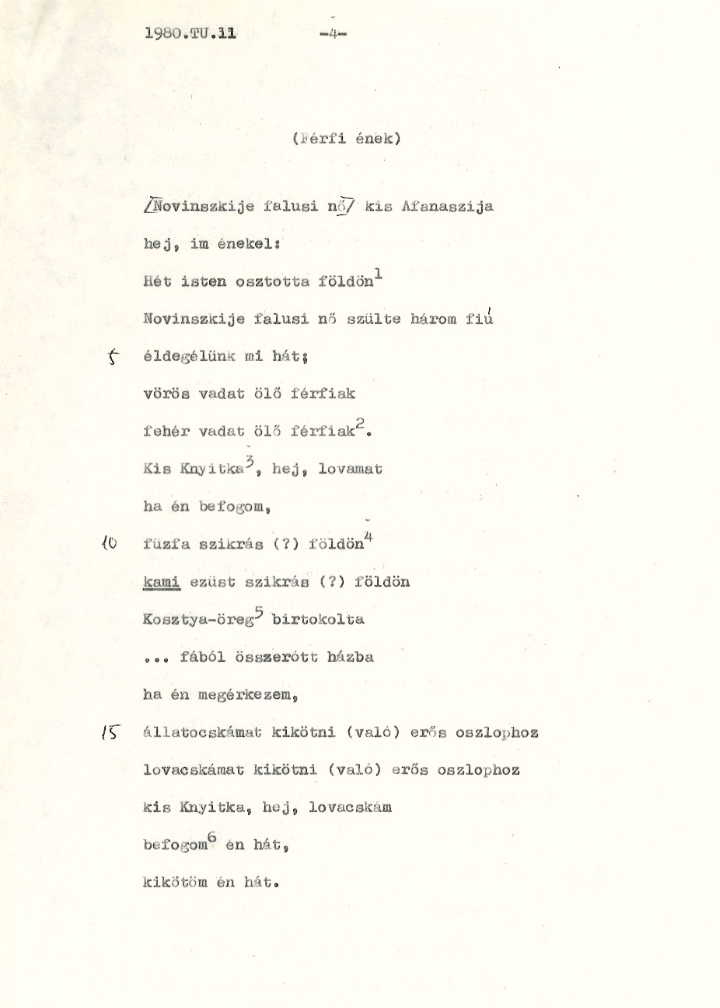
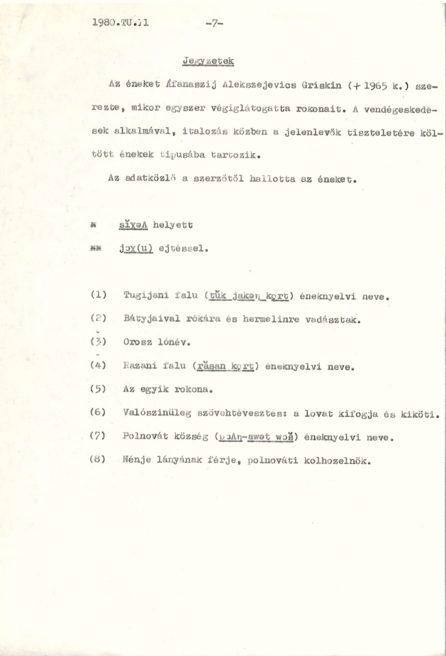
Metric tables are also part of the full analysis that Éva Schmidt aimed at, but these require a longer explanation, see below.
The English translations accessible at this time are based on the Hungarian texts. In finalising the texts to their present form, we observed the content of the manuscripts.
The presentation of the songs follow Éva Schmidt’s original processing, and also makes use of the opportunities inherent in online presentation: the user can listen to the recording and decide the language of the text displayed in the meantime, or choose to follow the tune in the musical score, or pick whether they are interested in the linguistic, ethnographic or folkloristic comments.
In the texts of varying length with background information about the songs, we can click through to access further details about the persons and settlements mentioned in them.
The explanations added to the Khanty (in rare cases Mansi) folklore texts can be viewed by hovering the cursor over the footnote numbers.
Metric tables demonstrate the methods that serve the placement of textual stress on the appropriate points of the musical line. The main tool used to this end is the insertion of filler syllables, filler morphemes and words in the text, following a well-defined set of rules. These tables are difficult to use in their faded manuscript format. To make subsequent research easier, we are publishing these in digitised versions (see below for the detailed legend attached to the tables).
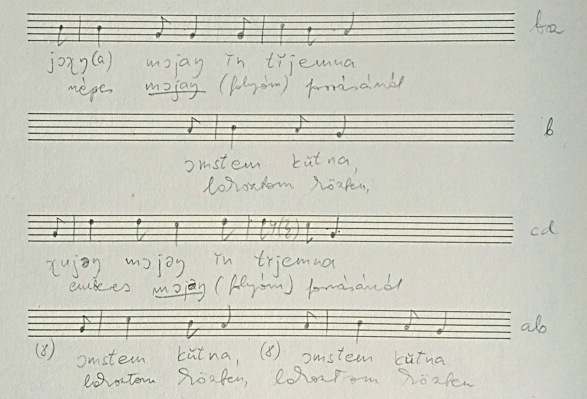
The musical scripts can also be viewed with a click. The scores are followed by short musicological analyses, also written by Katalin Lázár.
Copy editing
„lake-big-eyed- (that is, sighted) god”,
„sable-fur-smooth-prayer”, „water-monster-destroyed-high-shore”
and the like
are frequently used turns of phrase.
Éva Schmidt
The precisely executed Khanty language scripts, which were, for the most part, written on Éva Schmidt’s legendary typewriter equipped with diacritical signs and, in a lesser part, survived as handwritten manuscripts, have caused little trouble to us. The small number of marked uncertain or ambiguous places and ones for which different versions are available were finalised based on the form appearing in the metric table, which provides the most sophisticated analysis.
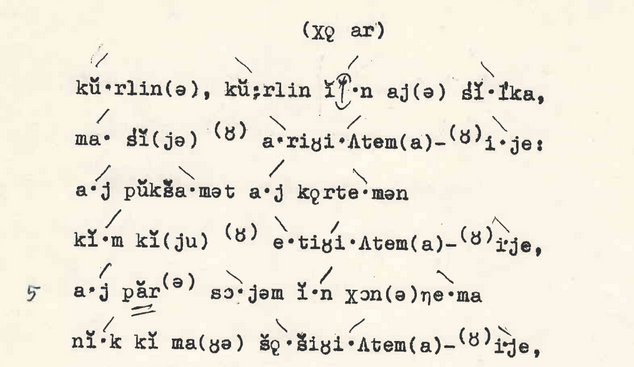
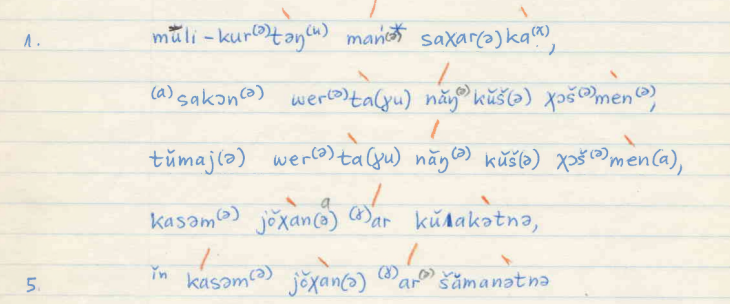
The Hungarian translation also survived on typewritten sheets. This mainly results in massive differences in the marks of vowel length, which were relatively easy to adjust to contemporary spelling rules. A bigger issue was the application of the rules of spelling compounds as one word or separate words.
In publications of Khanty folklore texts, there is a tendency to aim to follow the original linguistic elements directly in the Hungarian translation. In the treatment of locutions – following Éva Schmidt – we aimed to pick the solution that supports reception better. In particular, we hyphenated locutions if writing them in one word would have diverted the interpretation in a different direction. The phrase comprising the words girl and mother written separately is wrong in Hungarian, whereas written in one word, they would divert the thought in a different direction (e.g. ’unwed mother’). Hyphenation therefore is meant to designate that we are dealing with a formula or some kind of concept. So the Hungarian text diverts from rules of spelling separately or in one word when the meaning of the locution goes beyond a simple connection of the words, for example, girl-parent, girl-beauty, prince-shouldered,"kămi"-silver-sparked-sword, etc.
The scores put down by hand in the 1980s by Katalin Lázár were handed over by her in digitized form.
Translations
they reflect traces of the mastery of the trade to a certain degree,
but there is no way
to achieve the same effect
when the song is translated into a foreign language.
Éva Schmidt
It is a generally observable trait of Éva Schmidt’s translations that she aims to follow the grammatical structures of the original text as closely as possible. We found the same to be true of the Hungarian translations of the personal songs.
However, not all of the stylistic characteristics of the Khanty songs can be translated to another language. The study papers precisely reveal which characteristics of the Khanty original Éva Schmidt thought to be untranslatable into Hungarian .. We cannot authentically translate filler syllables and morphemes, but the problem usually does not affect the repetition of roots. Meanwhile, in Hungarian it is often impossible to put a filler word in the sentence position where we find it in the original. This applies to the range of words found before postpositions, for example in ’most jó végem jó után’ [lit. after now my good end good], or ’most jó végem most után’ [lit. after now my good end now] .. This also adds to the significance of metric tables, which can demonstrate through various print technological tools the kinds of components we find in song poetry.
In translating into Indo-European languages, we also adopted the principle of reflecting the grammatical structure of lines and the elements of the unique style as much as possible. Therefore these translations are deliberately not literary translations: it is their important aim to be suggestive of the structure of the original text as well.
Contributors
The original manuscripts (scripts, Hungarian translations, explanations, notes, metric tables) were digitized by Vitalij Sigil’etov.
The musical notations made in the 1980s on paper were handed over in digitized form by Katalin Lázár. Ágnes Kalivoda gave language technological support to this work, and Levente Kovács was available with technical support.
The folklore texts and notes were translated into English by Rita Kéri, and proofread done by Anna Fenyvesi and Melinda Széll. The comments were translated into Russian by Tatjana Jefremova. We requested Márta Csepregi to edit the Russian translations from an Ob-Ugric point of view.Ágnes Kalivoda provided the professional advice needed also for publishing the texts on the website, and she also took on the language technological tasks.
We are thankful to the Institute for Musicology of the HUN-REN Research Centre for the Humanities, as well as to Klára Erdélyi-Molnár for making available the audio recordings and the attached reports to us. The audio material was edited by Vitalij Sigil’etov.
Songs by genre
In what follows, we have grouped the songs according to the main genre categories provided by Éva Schmidt. If we could not find such a category in either the song’s information section or its documentation, it was labeled “No genre specified.”
- aj annuška lewanťɔwna…
- ĭn warwar(ǝ) paγ(a)lɔwna, paγ(a)lɔwna…
- kapar(a)ťin(ǝ)ka(ja), ješk(a) ne-leŋkǝ(ja)…
- aj(j) annuš(ǝ)ka(ja) tupurɔwna(jǝ)…
- pɔrkup ɔjka (γ) ĭn aj ľɔpka…
- wŏstijem pumǝ (γ) etmaŋ(a) mĭγ(a)…
- tŏχtǝŋ zɔja, (γ)aremǝtǝm(a)…
- wɔ̄tǝŋ(a) mišjur(ǝ) wātamen(ǝ)t(a)
- (χ) aj jŏχan-ɔw aj kǫrtijew
- păštar ĭmi(γǫ) (γ) ăŋki(γi)jem(ǫ)
- parskɔj ĭmen śĭ (γ) arijtaʌ(ǝ)
- jakǫw ĭki (γ) aj ɔńiśa
- tăm(ǝ) ʌaj χǫlǝŋ(ǫ) teʌǝp mŭwǝn(ǫ)
- wǫn wǫʌ́ǫška(γǫ), ma (γ) aśijem
- jŭmin jɔχʌan aj kĭrkǫri(ju)
- [kaj] ʌǫjŋije, kaj ʌǫjŋije(γǫ)
- [tŏχәt as]i χǫʌәm-le(γa) χŏr
- mŭj ăŋkem ar(i) ma (γ) arijtem
- kartijen tŏχʌǝp(a) tŏχʌǝŋ(aγa) χɔp
- ńǫrǝm ʌɔr tăm(ija) χŏśi
- [kaj, ťǫ]pijet, χǫʌǝntatǝn(ǫ)
- wǫntǫrǫška(γǫ) kărǝś(a) χɔt(ǫ)
- jekǫr ĭki (γ) ĭn aj(ǫ) waśka
- tarǝm šănšǝp kăt wǫn aki
- jarkin, jarkin, jarkin
no genre specified
bear ceremony performance song
men's song
women's song
Songs by singer
The songs are listed below, grouped by singer. Clicking on a name will display the first line of each song, from which you can access the full text of the given song.
- mătrɔnuška(ja) andrijɔwna(ja)…
- ĭn wɔjťem(ǝ) kĭŋ(ǝ)nǝp(a) tantǝŋ ńaras…
- ĭn χătt(a) kertǝm χăr mŭwemna(γa)…
- aj annuška lewanťɔwna…
- ĭn warwar(ǝ) paγ(a)lɔwna, paγ(a)lɔwna…
- kapar(a)ťin(ǝ)ka(ja), ješk(a) ne-leŋkǝ(ja)…
- aj(j) annuš(ǝ)ka(ja) tupurɔwna(jǝ)…
- pɔrkup ɔjka (γ) ĭn aj ľɔpka…
- wŏstijem pumǝ (γ) etmaŋ(a) mĭγ(a)…
- (χ)aj tɔw ɔtǝŋ(a) sĭrǝŋ(a) ne(ja)…
- tŏχtǝŋ zɔja, (γ)aremǝtǝm(a)…
- (n) juwan ɔ̄jka(γu) māń(ǝ) mikita(γu)…